
Share this post


Key takeaways from this article:
- Arbitrage is a real value pool for commercial sites, but it is volatile, sensitive to constraints and sensitive to settlement. As a Single-Use case, it rarely carries a project on its own.
- If you add up peak shaving + arbitrage + PV self-consumption, you count capacity twice. Multi-Use resolves the conflicting goals explicitly instead of hiding them in separate tabs.
- In practice, simultaneous optimisation delivers the larger return advantage over the best individual lever.
- It is not the biggest battery that achieves the highest return, but the correctly sized battery with the right priority logic.
- Multi-Use is a quarter-hour topic. Hourly models, missing cost per cycle and added-up use cases are the three most common mistakes.
The moment Single-Use fails
The storage system appears in the quote as an "arbitrage option". The conversation with the operator then almost always goes the same way: first it is about price spreads and "charge cheap, discharge expensive".
Then someone looks at the load profile, sees the load peaks, and asks why the storage system should not cut the peaks first. Once PV is involved, at the latest, the third layer comes in: "We throw away surplus at midday, can't we shift it?"
If you open three separate calculations at this point, one for arbitrage, one for peak shaving and one for PV, and add up the results at the end, you almost inevitably end up with a case that shines in the simulation and does not hold up in operation. The same battery cannot be fully available for all three goals at the same time. If you do not model this explicitly, you count capacity twice or three times.
So the question is not "Which use cases have potential?", but: Which goal priorities and constraints, working together, lead to which operating strategy, and to what overall value?
→ How arbitrage works as a standalone strategy for commercial sites (and where its limits lie): Electricity arbitrage for commercial sites: two operating models
What Multi-Use means in practice, and what it does not
Single-Use means: the storage system is sized and assessed for exactly one value pool, e.g. only arbitrage or only peak shaving.
Multi-Use means: the storage system is operated as a shared resource that can serve several value pools, but not all of them at full capacity at the same time. The control system decides for each quarter-hour which use currently creates the highest value, within all technical and contractual constraints.
Multi-Use is not "we add up several business cases". Multi-Use is "we resolve conflicting goals explicitly", and that is the decisive difference.
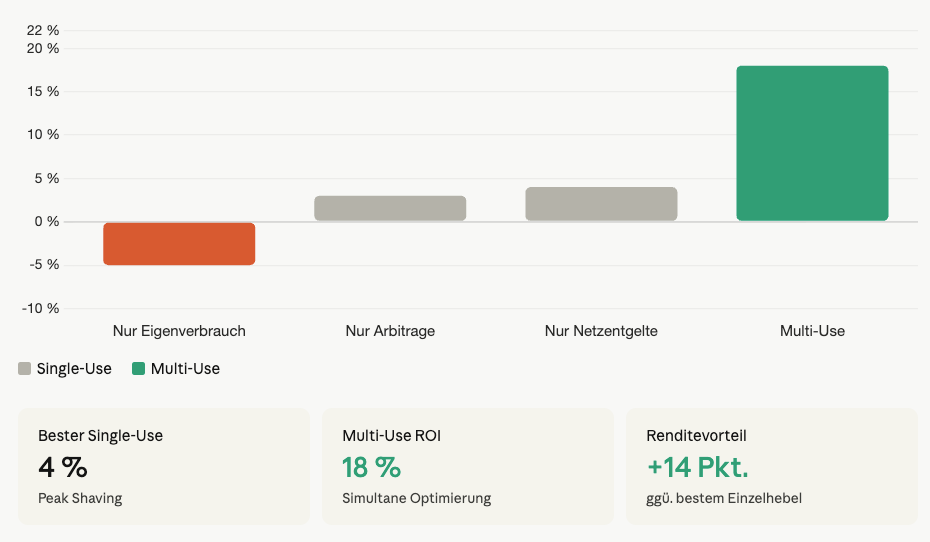
A case study at a commercial site shows this in numbers: self-consumption alone delivers -5% ROI, pure arbitrage +3% and peak shaving +4%, whereas Multi-Use operation delivers +18%. This is not because the individual levers were misjudged, but because only simultaneous optimisation resolves the interactions correctly.
→ The full scenario comparison (peak shaving, dynamic tariff, 100% Multi-Use): Use case: Retrofit BESS Multi-Use scenarios
A typical scenario as an example chart:
The three value pools, and why they get in each other's way in operation
1) Peak shaving: the storage system as insurance against expensive load peaks
For commercial sites, the grid connection is often the bottleneck. Load peaks are not an abstract figure but events: short spikes in power that become expensive through demand charges or contractual limits. A storage system can be very effective here, but it needs power exactly when the peak arrives, and a sufficient SoC buffer beforehand.
The conflict with arbitrage: If the storage system was discharged at night for arbitrage, it may be too empty for peak shaving in the morning when production ramps up. The spread was attractive, but the peak cost more than the arbitrage earned. In a Single-Use model, this conflict is invisible.
→ How SoC reservation and peak prioritisation work together in the EMS: Peak shaving in C&I: integration & Multi-Use in operation
2) Procurement and tariff optimisation: not just the exchange price, but the bill
Time-variable tariffs signal when energy is expensive or cheap. The storage system can shift load, but for commercial sites the "price" is rarely just the exchange value. Surcharges, time windows, grid fee components and demand charge components change the optimal operating strategy considerably.
The conflict with peak shaving: A storage system that is consistently geared to tariff optimisation runs on price, not on the load profile. It may discharge in expensive hours even though a peak is looming at exactly that time. Or it charges in cheap hours even though the reserve for the next HLZF (high-load time windows set by the German grid operator) period is missing.
→ Why tariff logic and spot market arbitrage are two different worlds: Arbitrage vs. dynamic tariffs for commercial sites
3) PV self-consumption: energy at the wrong time in the wrong place
PV delivers energy at times that do not always match the load. The storage system shifts PV surplus into periods of demand, but conflicts arise here too:
The conflict with peak shaving and arbitrage: If the storage system is fully charged at midday (PV surplus), there is no capacity left in the afternoon to absorb an arbitrage charge in cheap hours. And if the PV power was already used for self-consumption in the morning, the reserve for the evening peak is missing. Each individual decision looks right, but together they produce a suboptimal overall picture.
Why "adding up use cases" is almost always wrong
The common quote pattern is: "Peak shaving saves X" + "arbitrage earns Y" + "PV optimisation earns Z" ⇒ total X+Y+Z
In a Multi-Use context, this is wrong for three reasons:
First, the same battery cannot provide full power for all goals in the same hours at the same time. Second, constraints (SoC, connection, reserves) are each used "optimally" in the individual models, but are counted twice in the sum. Third, the optimal operating strategy changes fundamentally as soon as another goal is added.
The result: if you present X+Y+Z, you have a case that falls apart at the first question about how the battery is operated.
A concrete example: where Multi-Use wins day to day
Take a typical commercial site: 1,150 kWp PV, around 6,300 MWh annual demand, production operation with recurring afternoon load peaks, and a dynamic electricity tariff based on the Day-Ahead market.
Single-Use arbitrage would charge at night in this situation (low spot price) and discharge in the afternoon (high spot price). The battery is sized for the arbitrage optimum: small storage system, many cycles, attractive spread.
The problem: The strongest load peaks occur in exactly the afternoon, when the arbitrage discharge is running. The battery is busy, so the peaks go through. In addition, there is no capacity at midday to absorb PV surplus, because the storage system is already geared to the night charge.
Multi-Use solves this: Simultaneous optimisation recognises that in the afternoon, peak reserve is more valuable than arbitrage discharge. PV surplus is used to build up SoC without putting extra load on the grid connection. Arbitrage only happens when there is enough reserve, no peak risk arises and the spread really holds up after losses and cost per cycle.
The result in numbers (from the calculated case): peak shaving + self-consumption alone justify a storage system of ~160 kWh at 37% return and a 2.7-year payback period. Multi-Use with a dynamic tariff moves the optimum to ~1,400 kWh at 56% return and a 1.8-year payback period. This is not because more battery is better, but because the integrated model finds the real sweet spot. There are fewer "trading cycles", but the overall value is more stable, because expensive peak events are not accidentally made worse.
→ View the full calculated case: Use case: Retrofit BESS Multi-Use scenarios
{{use-case}}
Mini framework: setting up Multi-Use so that it holds up in the quote
Step 1: Prioritise goals clearly
You need a goal hierarchy that is understandable and traceable in operation. Typical for commercial sites:
- Constraint-first: always respect connection and peak limits and no-gos
- Cost stability: optimise procurement and tariff as far as the constraints allow
- Opportunistic: energy marketing and arbitrage when there is enough reserve and no peak risk
This prevents arbitrage from accidentally creating peak risks, and protects the case from the "worked in the simulation, but not in operation" trap.
Step 2: Model constraints as hard boundary conditions
Multi-Use without hard constraints is a wish list. At a minimum, define these cleanly:
- Import and export limits at the grid connection
- SoC windows and reserves (e.g. peak reserve)
- Charge and discharge power (kW), ramps, minimum run times
- Cost per cycle and degradation as a cost block, otherwise the model runs too many small cycles
Step 3: Choose a suitable time step and data basis
Multi-Use is a quarter-hour topic. If you model hourly, you systematically get conflicting goals wrong: peaks are smoothed, reserves are built up too late, and the battery looks more flexible in the model than in operation.
→ Why the time resolution decides the quality of the model: Analysing load profiles correctly
Step 4: Present the result as a decision basis, not as "one number"
For EPCs and operators, the maximised figure is not what matters. What matters is: Which operating strategy results? Which sensitivities dominate? How robust is the result under conservative assumptions?
In practice, this means: at least 3 scenarios (conservative, realistic, optimistic) and 5 to 7 sensitivities: price and tariff, peak intensity, efficiency, cost per cycle, connection limit, reserve policy and PV surplus.
Typical anti-patterns in Multi-Use
Anti-pattern 1: "Peak shaving first, then arbitrage" as a heuristic This sounds pragmatic, but it leads to a suboptimal operating strategy, because reserves and time windows are not planned cleanly. Better: simultaneous optimisation with explicit prioritisation.
Anti-pattern 2: Adding up use cases If you present X+Y+Z without modelling the interactions, critical follow-up questions are guaranteed, and justified. Better: an integrated model and a transparent decision basis.
Anti-pattern 3: Ignoring cost per cycle Without cost per cycle, Multi-Use in the model turns into "always run, take every spread everywhere". In operation, however, you only want to use the time windows where something really remains after losses and wear.
Anti-pattern 4: 15-minute data is missing Multi-Use is then run conservatively, with large reserves and few opportunities, and the case falls short of expectations.
Side note: the metering concept as the limit of monetisation
Multi-Use at an existing grid connection gets really good when energy marketing and arbitrage can be cleanly integrated as an additional value pool. In practice, a simple question often stands in the way: Can I clearly allocate and bill the energy flows?
That is why delineation, meaning quarter-hour logic, metering set-up and data access, is not a regulatory footnote but a project prerequisite. MiSpeL (German BNetzA rules for storage that charges both grid power and on-site renewable power) has created reliable foundations here since 2026. Multi-Use is only as good as the metering concept behind it.
→ We explain what MiSpeL means for Multi-Use at an existing grid connection here: MiSpeL & delineation in mixed operation: what Multi-Use makes possible at an existing grid connection
Further links
- Use case: Retrofit BESS Multi-Use scenarios: peak shaving, self-consumption, dynamic tariff and 100% Multi-Use compared directly
- Use case: MiSpeL-compliant storage sizing for arbitrage 2026: how arbitrage is calculated in line with MiSpeL as part of Multi-Use
- Blog: Calculating electricity arbitrage properly: 7 parameters that Excel leaves out: the modelling basics for robust arbitrage cases
- Blog: Arbitrage vs. dynamic tariffs: why tariff optimisation and spot arbitrage follow different calculation logic
We use AI to support research, structuring and language editing. minimum.energy is responsible for the technical content, classification and approval. Figures, claims and project-specific statements are checked before publication.
Commercial and industrial (C&I): retrofitting BESS, Multi-Use scenarios
Industrial site in NRW with 9.3 GWh consumption and existing PV: three storage system scenarios across two grid fees regimes. The smaller storage system with a dynamic tariff beats 5 MWh Multi-Use.

323k
1.1 yrs
2.86M
-23%
Ready for quotes that actually hold up?
Bring an example project. In 30 minutes, we will show you how minimum energy transforms your pre-sales process.