

Share this post


Too many battery storage systems are still used below their potential.
They buffer some self-consumption, and that is it. There is much more to gain.
What gets lost? Simply: cash flow.
If you think of storage strategically, you activate three key levers for economic viability:
Self-consumption optimisation: reduces direct electricity procurement costs
Arbitrage (Day-Ahead & Intraday): uses price fluctuations for electricity trading
Grid fee reduction: e.g. through atypische Netznutzung (atypical grid usage under § 19(2) StromNEV, reduced grid fees for shifting load out of HLZF)
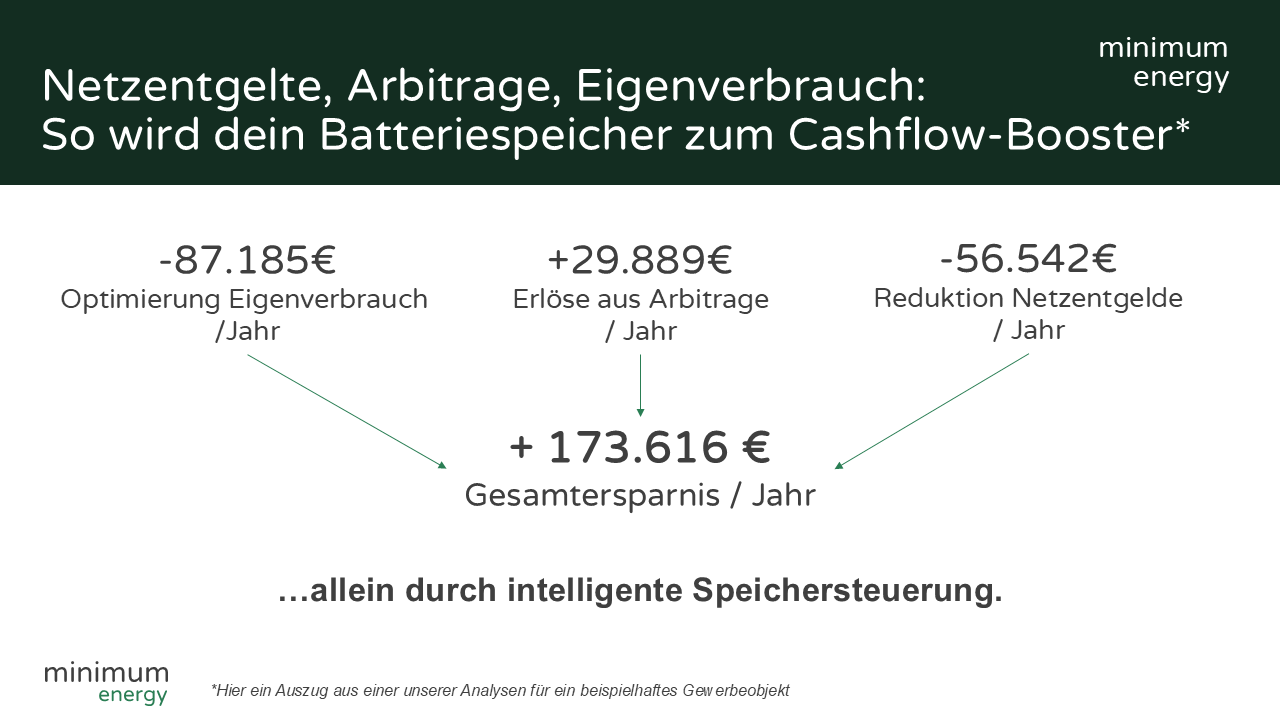
What does that mean in concrete terms? Here is an extract from one of our analyses for an example commercial site:
Self-consumption optimisation: -€87,185/year
Arbitrage revenue: +€29,889/year
Grid fee reduction: -€56,542/year
Total savings: €173,616/year, from intelligent storage control alone.
Only if you think of use cases as an integrated whole can you really unlock them.
Our approach at minimum energy:
Multi-criteria optimisation of all economically relevant use cases
Inclusion of price signals, grid fee logic and dynamic electricity tariffs
15-minute modelling of all storage states, including technical limits
Scenario comparison for strategic decisions
Conclusion:
Battery storage is more than backup. It is a strategic asset.
And if you use it properly, you turn technology into cash flow.
Let’s optimise it.
{{cta}}
We use AI to support research, structuring and language editing. minimum.energy is responsible for the technical content, classification and approval. Figures, claims and project-specific statements are checked before publication.
Commercial and industrial (C&I): retrofitting BESS, Multi-Use scenarios
Industrial site in NRW with 9.3 GWh consumption and existing PV: three storage system scenarios across two grid fees regimes. The smaller storage system with a dynamic tariff beats 5 MWh Multi-Use.

323k
1.1 yrs
2.86M
-23%
Ready for quotes that actually hold up?
Bring an example project. In 30 minutes, we will show you how minimum energy transforms your pre-sales process.