
Share this post


Key takeaways from this article:
Why this matters
For commercial and industrial (C&I) customers, grid fees make up a considerable share of electricity costs. What counts is not only the energy consumed (kWh), but above all the maximum quarter-hourly demand measured (kW).
This is exactly where the 2.500-Stunden-Regelung under § 19 StromNEV comes in: companies with consistently high electricity consumption (utilisation hours above 2,500 per year) can reduce grid fees significantly. In practice, peak shaving with battery storage is the key lever for realising these benefits.
Basics: the 2.500-Stunden-Regelung
- From utilisation hours ≥ 2,500 h (consumption ÷ highest load peak), a reduced grid fee applies.
- Requirements:
- Annual consumption ≥ 10 GWh per offtake point
- Proof of at least 2,500 utilisation hours
- Annual consumption ≥ 10 GWh per offtake point
- Companies with an even load profile get relief, while sites with high load peaks pay more.
Without reaching this threshold, you cannot apply for special grid fees.
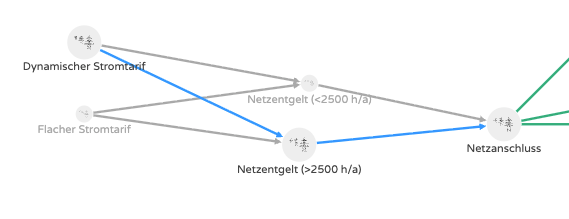
How it links to peak shaving
Peak shaving means cutting load peaks so that the maximum quarter-hourly demand falls.
This has two direct effects:
- Access to the scheme: The utilisation hours rise in the calculation, so companies pass the 2,500 h mark.
- Direct cost reduction: The demand charge in the grid fees falls regardless of the scheme.
Connection:
- “We have an atypical load profile” → requirement for special grid fees.
- “We reduce our highest load peak” → direct lever for cutting costs.
{{cta}}
Legal framework
- § 20 EnWG, ARegV, § 19 StromNEV
- Simultaneity function:
- 0 h = max. simultaneity factor of 0.2
- 2,500 h = inflection point
- 8,760 h = simultaneity factor of 1
- 0 h = max. simultaneity factor of 0.2
The Bundesnetzagentur (BNetzA, Germany's Federal Network Agency) reviews and approves individual agreements. Revenue shortfalls of grid operators are distributed nationwide through the § 19 levy (2025: 1.553 ct/kWh).
Calculating utilisation hours
Utilisation hours [h]=Annual consumption [kWh]maximum quarter-hourly demand [kW]\text{Utilisation hours [h]} = \frac{\text{Annual consumption [kWh]}}{\text{maximum quarter-hourly demand [kW]}}Utilisation hours [h]=maximum quarter-hourly demand [kW]Annual consumption [kWh]
- High maximum quarter-hourly demand = low utilisation hours
- Peak shaving = smoothed load → more utilisation hours
Battery storage as the key
Grid-scale storage improves grid fees in two ways:
- Enabling entry: Peak shaving lifts you above the 2,500 h threshold.
- Cutting costs: Even after entering the scheme, a storage system permanently reduces the maximum quarter-hourly demand and with it the demand charge.
{{use-case}}
Conclusion
The 2.500-Stunden-Regelung sets the framework, and peak shaving is the method for realising its benefits. Companies with high consumption and an even load can save significantly on grid fees this way, legally secure and technically scalable.
Your next step
With minimum.energy you simulate load profiles, tariffs and storage strategies in a single run, including proof for the 2.500-Stunden-Regelung.
We use AI to support research, structuring and language editing. minimum.energy is responsible for the technical content, classification and approval. Figures, claims and project-specific statements are checked before publication.
Flexibility-based grid fees: § 19 StromNEV vs. the AgNes pilot concept
6 scenarios show that flexibility-based grid fees alone do not carry the BESS investment. Only the combination with dynamic electricity procurement delivers an NPV of +€141,223 at a 12.1% return.

+141k
12,1%
7.5 yrs
57.7k
Ready for quotes that actually hold up?
Bring an example project. In 30 minutes, we will show you how minimum energy transforms your pre-sales process.