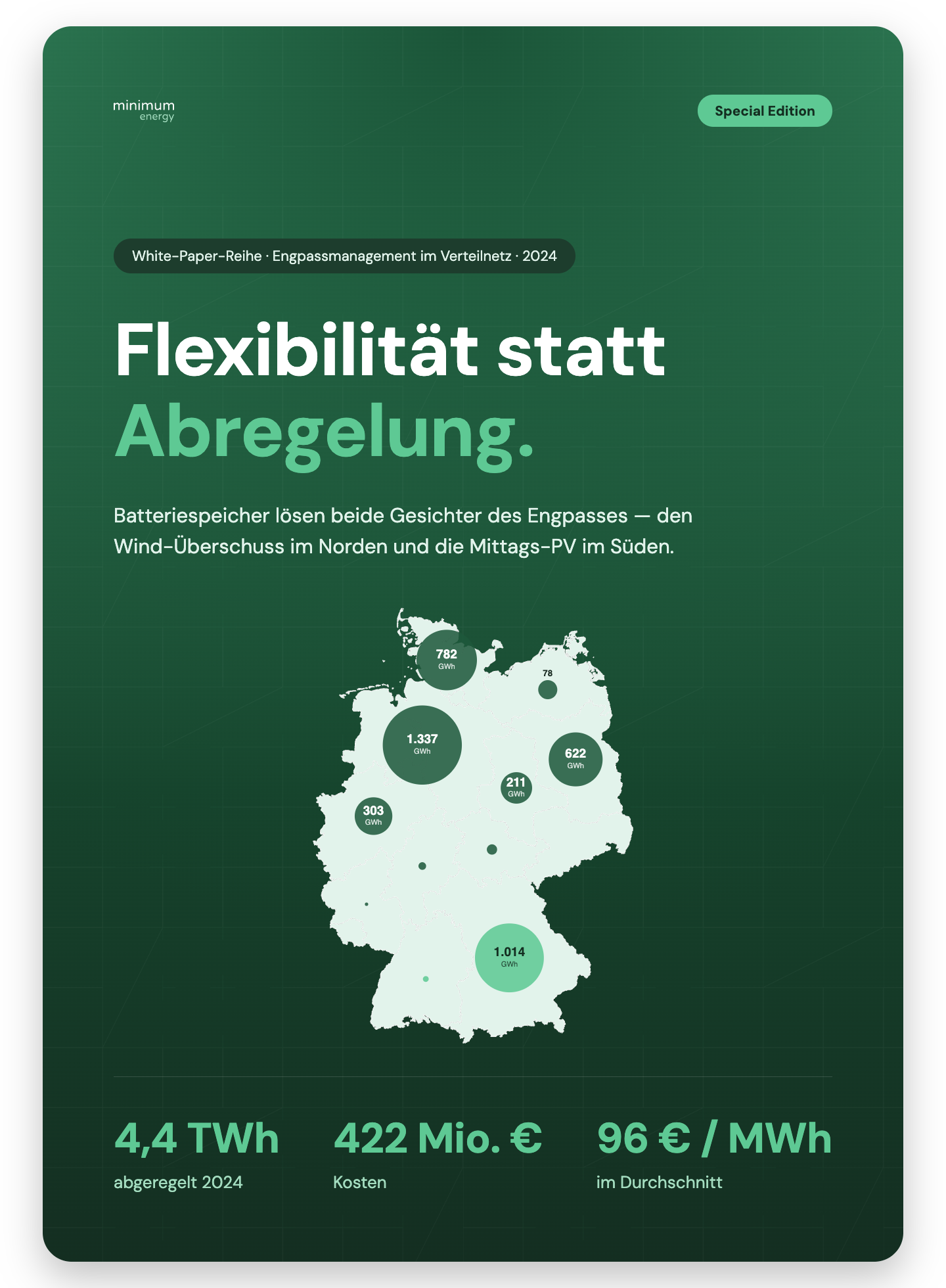
Flexibility instead of curtailment

4.4 TWh of green electricity were curtailed in German distribution networks in 2024. We have analysed the data of the 20 largest distribution system operators.
iPhone mockup
Dashboard mockupDashboard mockup

4.4 TWh produced, but never delivered.

In 2024, 4.4 TWh of renewable electricity were curtailed in German distribution networks. The data comes from our own IFG request to the Bundesnetzagentur (BNetzA, Germany's Federal Network Agency), analysed for the 20 largest distribution system operators. We have not seen a dataset in this form before.

Three findings from the report:

  • More than half is home-made. 55.4% of curtailment consists of the distribution system operators' own measures. The bottleneck is in their own network, not in the transmission grid.
  • Wind in the north, almost only PV in Bavaria. Bayernwerk curtails 99.8% PV, N-ERGIE 93%, together over 1 TWh. At SH Netz, 97% is wind.
  • Flexibility is cheaper than throwing energy away. Storage systems do not react to curtailment, they make it necessary less often: they absorb the feed-in peaks that cause the bottleneck. Behind the meter in the south, front of the meter in the north. From AgNes (BNetzA reform of German grid fees towards capacity-based pricing) onwards, exactly this relief is remunerated.

The cost: €422 million, passed on to grid fees. That is €96 per MWh not delivered.

Download the full report for free

C&I: MiSpeL-compliant storage sizing for arbitrage 2026

A C&I site with existing PV is assessing how battery storage can move from a pure cost optimiser to a MiSpeL-ready market revenue asset.

290k

Savings/year

866k

Net present value (NPV)

262 MWh

Running costs

-42%

Running costs
View Use Case →

Commercial and industrial (C&I): retrofitting BESS, Multi-Use scenarios

Industrial site in NRW with 9.3 GWh consumption and existing PV: three storage system scenarios across two grid fees regimes. The smaller storage system with a dynamic tariff beats 5 MWh Multi-Use.

323k

Initial investment

1.1 yrs

Payback period

2.86M

Electricity costs year 1

-23%

Electricity costs year 1
View Use Case →

Cross-market instead of arbitrage-only: How FCR and aFRR almost triple the net present value of a 10 MW BESS

10 MW grid connection, standalone BESS: arbitrage alone delivers a net present value of €6.3 million. With FCR and aFRR in the stack, it becomes €17.3 million, and a grid operator's ramping requirement can be quantified to the euro.

40,9 %

Return (max.)

17.3 million

Net present value (max.)

2.4 yrs

vs. arbitrage-only

2,7×

vs. arbitrage-only
View Use Case →