
Share this post


Why simulations reach their limits in complex energy systems, and mathematical optimisation is superior.
Many energy projects use simulations to analyse the effects of specific decisions.
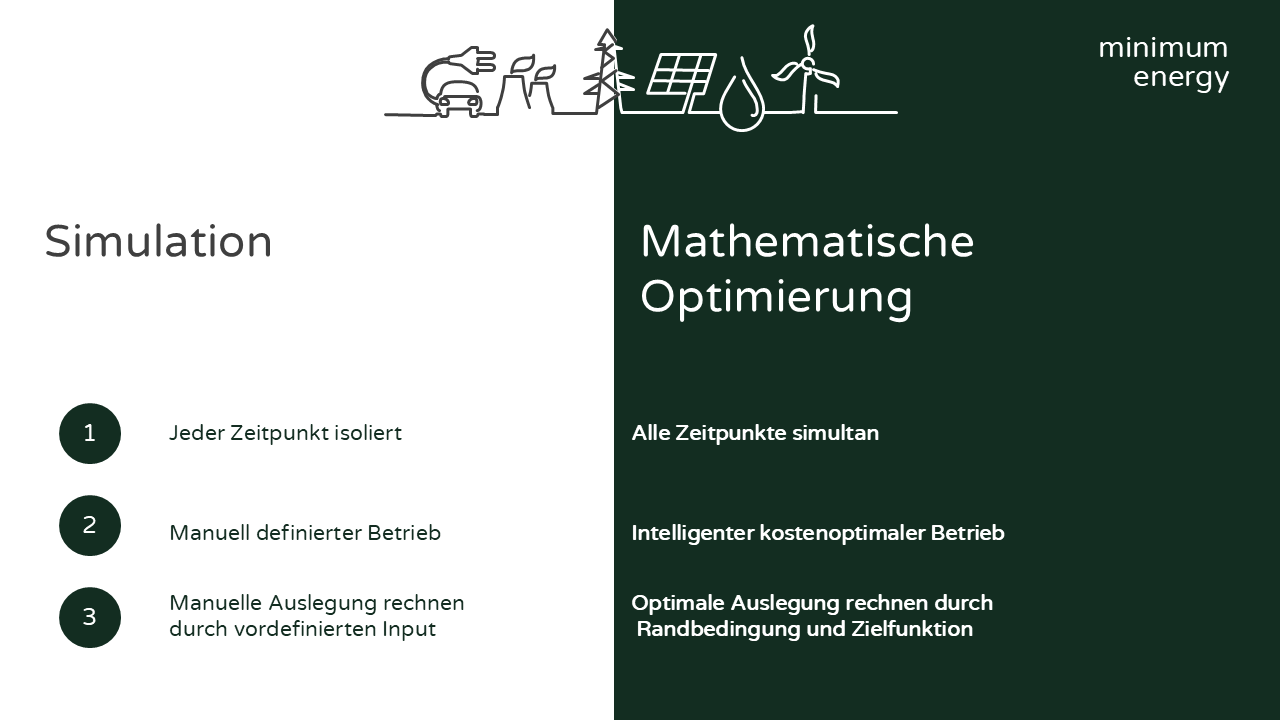
However, these methods usually look at isolated scenarios and control options.
As a result, forecast errors, volatile electricity prices and fluctuating consumption cannot be taken into account efficiently.
Mathematical optimisation addresses this complexity systematically.
Instead of assessing individual points in time separately (simulation), mathematical optimisation considers all 35,040 quarter-hours of a year simultaneously:
Electricity consumption, PV generation, power exchange prices and grid fees are modelled together.
Every decision at one point in time affects all future points in time. For example, the optimal state of charge of a battery storage depends on whether and when cheap opportunities to charge or sell arise.
Mathematical optimisation thus enables holistic decision-making:
It assesses scenarios in their overall context rather than in isolated moments.
It identifies optimal operating strategies, taking economic conditions and real uncertainties into account.
Conclusion:
Simulation delivers snapshots.
Mathematical optimisation delivers reliable strategies for dynamic energy systems.
We use AI to support research, structuring and language editing. minimum.energy is responsible for the technical content, classification and approval. Figures, claims and project-specific statements are checked before publication.
Ready for quotes that actually hold up?
Bring an example project. In 30 minutes, we will show you how minimum energy transforms your pre-sales process.