
Share this post


Key takeaways from this article:
1. MiSpeL: what is changing
With the introduction of the metering procedure for verifying the separation option (MiSpeL), the Bundesnetzagentur (BNetzA) is specifying how different electricity origins must be distinguished in future.
While the simple split between green electricity and grid electricity applied until now, the new rule requires three-way accounting:
- Green electricity: locally generated (green) and stored (yellow) PV or renewable electricity
- Grid electricity: conventional electricity purchased and consumed from the public grid or local systems (black)
- Arbitrage electricity: electricity purchased specifically, temporarily stored and exempt from levies, for price optimisation ("netting-eligible" share, red)
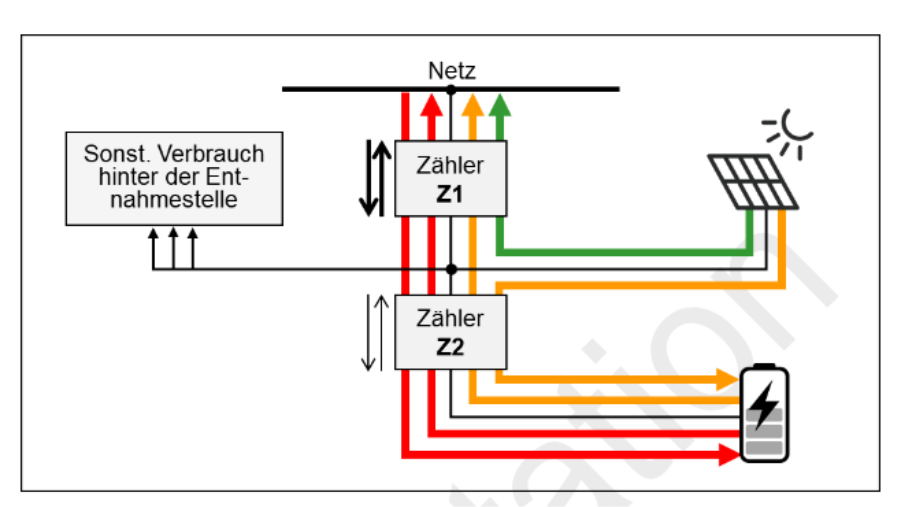
This third category is new, and it fundamentally changes how storage system planning and system simulation are understood.
MiSpeL is part of the Solarspitzengesetz (German solar peak law of February 2025) and is intended to enable the market integration of storage systems and charging points. The aim is to make storage systems economically usable without losing EEG support, which means real system flexibility instead of rigid exclusivity rules.
2. Why MiSpeL is more than regulation
MiSpeL is not a niche topic. It is a real turning point for system planners and EPCs.
The correct separation of these three energy flows will determine:
- the eligibility for support of fed-in electricity (EEG § 19(3b) and (3c)),
- the exemption from levies under § 21 EnFG,
- and the economic viability of a project.
According to current estimates by the Bundesnetzagentur, 10–40% of the energy volumes in hybrid PV storage systems may be arbitrage electricity. With price differences of €50–100/MWh, that means a potential additional annual revenue of €5,000–30,000, provided the separation is done cleanly.
3. Two options, one goal: compliant flexibility
The BNetzA introduces two technical procedures to implement MiSpeL:
(a) Separation option: precision on a 15-minute basis
Here, each 15-minute interval is balanced individually.
In line with EEG § 19(3b), the system calculates exactly which share of the stored electricity comes from PV (eligible for support) and which from the grid (not eligible for support).
This "separation fiction" is applied using high-resolution time series and clearly defined priority rules: the grid share is always deemed to be fed in first, and only then the green electricity share.
This creates a legally robust and audit-proof model that also works for DC-coupled storage systems.
Example:
A 1 MWh storage system charges 600 kWh of PV electricity and 400 kWh of grid electricity during the day.
In the evening, 800 kWh are fed in.
→ 400 kWh count as grid electricity (not eligible for support), 400 kWh as green electricity (eligible for support).
This option is aimed at larger, professionally operated systems and requires interval metering with 15-minute resolution.
(b) Flat-rate option: simplification for small systems
For PV storage systems up to 30 kWp, the flat-rate option offers a simplified procedure:
Up to 500 kWh per kWp of installed PV capacity count as stored green electricity on a flat-rate basis and receive full support, without 15-minute metering.
Any volumes above that are automatically treated as grid electricity feed-in.
Prerequisite: only PV systems, storage systems and bidirectional charging points may be operated behind the same feed-in point.
As of Q4 2025, the flat-rate option has not yet been cleared under state aid rules, but it is due to come into force in 2026.

4. What planners and EPCs need to know now
For planners, MiSpeL means the era of simplified energy volume models is over.
From now on, every 15-minute interval counts.
This has direct consequences for project planning:
- Simulations must represent time-resolved electricity flows (PV → storage system → grid).
- With dynamic tariffs (EPEX Spot, redispatch 2.0), price and grid fee logic must be integrated.
- Metering concepts require several meter points (grid connection, storage system, and a charging point where applicable).
- All data must be synchronised and recorded in line with interval metering requirements.
For existing systems, this often means retrofitting smart meters or adding metering points.
The aim of the Bundesnetzagentur is to create uniform, verifiable rules so that storage system operators can in future act in a way that is eligible for support, active in the market and beneficial to the system.
5. Economic dimension: support meets market logic
MiSpeL brings a clear economic advantage for storage system operators:
- EEG support is retained proportionally, even if the storage system takes in grid electricity.
- Levies & taxes on electricity fed back into the grid are partly waived (§ 21 EnFG):
- CHP and offshore levy: approx. 1.09 ct/kWh
- § 19 StromNEV levy: approx. 1.56 ct/kWh
- Electricity tax (planned): 2.05 ct/kWh
→ potentially up to 4–5 ct/kWh relief on volumes fed back into the grid.
For large C&I storage systems with 1 MWh capacity and ~300 cycles a year, this equates to savings of around €15,000–20,000 a year, while also improving grid efficiency.
{{use-case}}
6. The timeline
This is what the current timeline looks like:
- September 2025: draft published by the Bundesnetzagentur
- October 2025: MiSpeL workshop and consultation
- by 30 June 2026: determination to be completed (statutory deadline)
- from 2026: separation option usable, flat-rate option after EU approval
As a result, storage system planning is shifting from a "PV plus storage" mindset to integrated energy system modelling, which brings together the regulatory, technical and economic levels.
7. How minimum energy masters this complexity
minimum energy was developed out of academia, at the intersection of mathematical optimisation, energy market logic and regulatory modelling.
Our aim: "Understand complexity, model it precisely and make it usable in practice."
Our platform already:
- models green electricity and grid electricity flows separately,
- integrates time-resolved price signals and grid fees,
- and enables compliant simulations for EEG, EnFG and StromNEV scenarios.
With the upcoming MiSpeL update, we will:
- introduce arbitrage electricity as a third electricity category,
- model the BNetzA's separation logic (15-minute intervals) directly in the model,
- and so enable MiSpeL-compliant project simulations: automated, transparent and scientifically sound.
This is how we deliver what MiSpeL demands but hardly anyone can provide:
Regulatory precision with technical simplicity.
8. Conclusion
MiSpeL marks the start of a new phase in the energy industry: regulation becomes measurable, flexibility becomes plannable. For EPCs, planners and operators, this is both a challenge and an opportunity.
minimum energy combines scientific depth with market-ready technology. We develop software that does not just simulate assets but understands rules, from EEG § 19 and EnFG § 21 to price arbitrage and dynamic grid fees.
minimum energy: software for the energy markets of the future.
Precise. Compliant. Scientifically sound.
We use AI to support research, structuring and language editing. minimum.energy is responsible for the technical content, classification and approval. Figures, claims and project-specific statements are checked before publication.
C&I (commercial and industrial): one storage system, all revenues. The same storage system with and without MiSpeL
A commercial site with 750 kWp of PV is assessing a 2 MWh storage system. The same storage system, calculated twice: with full grid fees and levies on the trading electricity, and MiSpeL-compliant. The net present value (NPV) rises from €287,000 to €762,000.

132k
762k
3.8 yrs
2,7×
Ready for quotes that actually hold up?
Bring an example project. In 30 minutes, we will show you how minimum energy transforms your pre-sales process.