

01 · The integrator
When the PV system was still the centre
For years, the business followed the same pattern: the customer comes through referrals, the PV system is at the centre of the energy system, and the route to an order runs through an indicative quote with an Excel profitability calculation. From the first meeting to the pre-planned quote, two to three weeks passed, and it took two to five meetings to reach a commitment.
Anyone who wanted to compare scenarios built a separate quote for each one. The storage design ran through the manufacturers' online portals, sometimes better, sometimes worse, never independent. And sales received results from technical planning that it could not explain. “Going into the customer conversation with that level of knowledge does not work in practice,” says Heiko Gehlen today.
“We produced a great many quotes for the bin. We knew that we were making four quotes now, but at most one of them could be ordered.”
Heiko Gehlen, Head of Sales
That was not a failure, it was the industry norm. It simply stopped working.
02 · The break
“Which projects do we actually make money with?”
Heiko Gehlen came from technical planning, where he had long wanted a manufacturer-independent design tool. Then he took over as Head of Sales, and the new role brought a question that stood above individual projects: which projects does B&W actually make money with?
At the same time, the market was shifting faster than ever. “There has always been change since the EEG came into being,” says Heiko. “But nothing has ever changed as fast as battery storage is changing now. And the complexity has risen massively.” A market in which revenue models, regulation and technology are all changing at once can no longer be sold with Excel and manufacturer portals.
The answer to both was the same: B&W makes money where the team is deeper into the project than the competition. So whoever sits with the customer must have mastered the project themselves. Not the planning team in the background, but sales at the table.
03 · The rebuild
The design moves into sales
“Whoever advises is the one who sells. They have to do the design, to get to grips with the project and to work out the competitive advantage.”
Heiko Gehlen, Head of Sales
Many competitors shy away from exactly this step: too much engineering, too much risk in field sales. Heiko took it anyway, with minimum as the tool. There were doubts, and it took a learning curve. The biggest hurdle was the price iteration: estimate the storage size, enter prices, the optimisation designs a larger system, then update with the new prices. “You have to play around at the start and get a feel for it. But once you have absorbed it, it is relatively intuitive.”
The doubts disappeared as soon as the first sales staff saw the effect in their own projects. What mattered was that the head of sales led by example and worked in the tool himself. Today, inside sales and field sales do the design in tandems. And it remains a matter of practice: “It is like an instrument. If you do not practise regularly, you cannot play it.”
04 · The solution provider
Advising rather than quoting
The result of the restructuring is a sales process that has little in common with the old one.
The integrator (then):
- Indicative quote after 2 to 3 weeks
- Four quotes calculated, one ordered
- Design happens in planning, and sales does not know the reasons behind it
- Storage system design via manufacturer portals
- Follow-up questions are taken home
The solution provider (today):
- Reliable design the day after the load profile
- Scenarios live in the meeting, including those that do not pay off
- Sales does the design itself and can explain every number
- Manufacturer-independent, one system for all assets
- The customer decides at the table
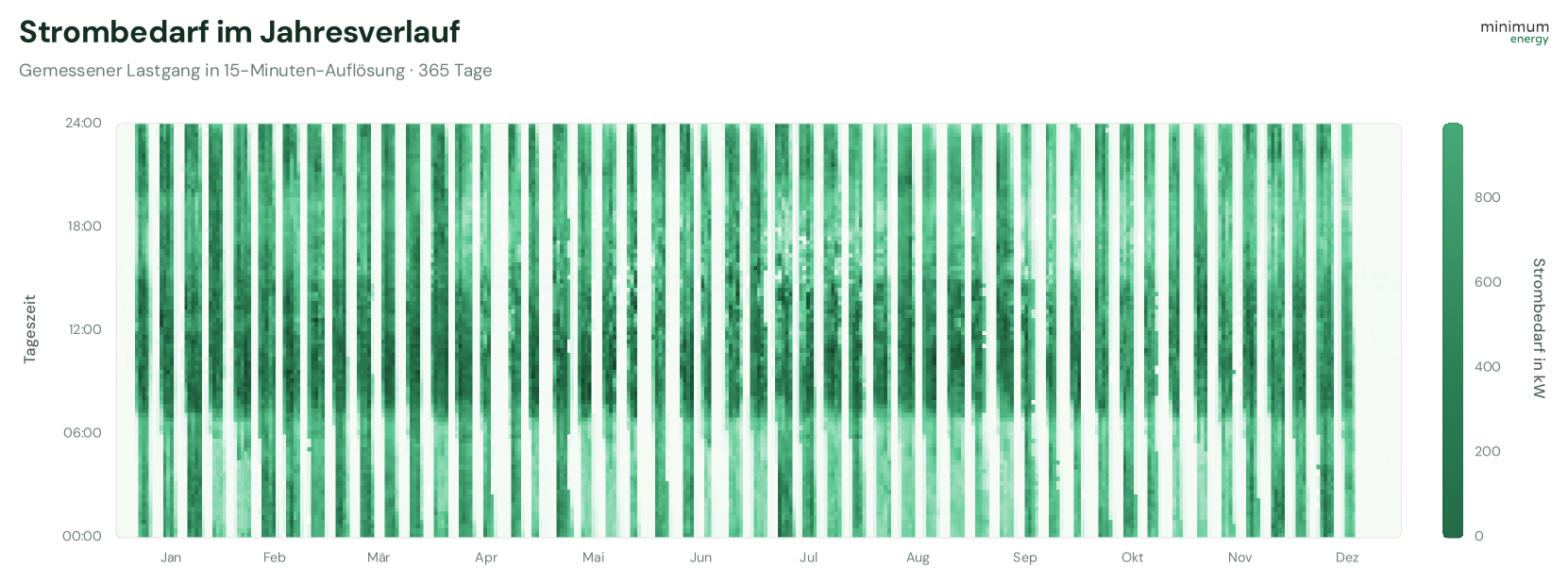
Today the conversation starts with the customer's current situation, not with a product. The heatmap of electricity purchasing shows company shutdowns, weekend working and the times of day when power is used. “In some cases we end up discussing with the customer how he can optimise his operation before he has done anything at all.” An existing customer had previously paid €15,000 to an energy consultant and received results that were presented less well than in B&W's initial consultation. Heiko's conclusion from such meetings: “In the end this is energy consulting. We have to bring the technology and the commercial side together.”
A target customer that B&W had been working on for five to six years showed how far this approach goes. Managing director and technical manager at the table, first investment in PV plus storage. Instead of taking questions home, Heiko calculated live, larger storage, smaller storage, until the design worked for everyone.
“We did not drive home with homework. We kept calculating until we had found the right design for everyone. When the customer sees how the tool works, it builds confidence.”
Heiko Gehlen, Head of Sales
The deal: clearly in the seven figures. Would it have come about without the software? “Definitely not.”
Overall, for projects with this depth of consulting, B&W estimates the close rate at well over 50%, against 15 to 20% typical for the industry. Heiko puts this in perspective: it is not the software alone, but the approach behind it. But the software makes the approach scalable in day-to-day work. And the effect reaches into the competition: some customers ask competitors whether they also work with minimum. If the answer was no, the conversation was quickly over.
05 · The new business model
The storage system is the centre of the energy system
The transformation now shows in the foundations of the business. Today a storage system can be shown to pay off in 95% of commercial projects, and with every component that can be shown to pay off, the order value grows. “As soon as we can show the customer that the storage system makes sense, the order value goes up.” Overall, B&W estimates that revenue per order is now 30 to 40% higher.
For Heiko, the order matters here: the order value rises because the customer gets the most economical system, not the other way round. A component only goes into the quote if the calculation supports it, and in the same way B&W also shows the customer the scenarios that do not pay off. In the end the customer benefits: they get the ideal energy system for their site and get the maximum out of their system over its whole lifetime. The larger project is a consequence of this, not the goal.
The shift in numbers: around 150 MWp of installed photovoltaics last year, plus over 200 MWh of storage capacity in the order book. In future, 30 to 50% of revenue is meant to come from battery storage. “Strictly speaking, a PV system without a storage system no longer has any justification today.”
This changes how the company sees itself: “We are no longer a typical system builder, but a partner to the customer in energy services.” According to Heiko, competitors who still sell only a PV system or only a storage system are going under. And there is no going back. Asked what would happen if minimum no longer existed tomorrow, he replies dryly that he would have a new tool the day after: “We cannot do without it. Not in the way we want to sell projects. The market no longer allows it. A design tool is indispensable.”
“20 years ago we had to explain to customers that those blue panels on the roof really do produce electricity. Today we have to explain how battery storage works. In ten years nobody will ask. But we have to deliver now.”
Heiko Gehlen, Head of Sales, B&W Energy GmbH & Co. KG


