
Share this post


Key takeaways from this article:
On 6 August, the Bundesnetzagentur presented the draft of the new grid fee system AgNes. For storage projects, it reverses the planning logic: the economically decisive points are now set before the investment. And the tightest deadline falls this year.
Note on status: This article is based on the AgNes draft determination of the Large Ruling Chamber for Energy (reference GBK-25-01-1#3, 198 pages). This is a draft, not a final decision. The consultation ran until 18 September 2026. Individual provisions may change. Where this is particularly likely or legally open, we say so.
What AgNes changes and from when
AgNes overhauls grid fees from the ground up. The draft broadens the funding base of the grids: for the first time, generators, storage systems and electrolysers also pay. In return, almost all existing special rules fall away.
Precision matters on the timetable, because a lot of inaccurate information is circulating. The determination is due to be published on 1 January 2027. The new charges only apply from 1 January 2029, and the StromNEV continues to apply in between. Even so, 1 January 2027 is not a date to file away: it is the cut-off date for protection of legitimate expectations, more on this below.
Capacity charge for storage systems: around €5 per kilowatt and year
Grid-connected storage systems will in future pay a capacity charge on 100% of the contractually agreed grid connection capacity. No energy charges, and no option to book a lower capacity. The level matches the new feed-in charge for generators. In the draft's model calculations this is around €5 per kilowatt and year, while the historical range of the calculation basis is €3.20 to €6.10, smoothed over a rolling five-year average (para. 387). The frequently quoted range of €4 to €7 comes from the orientation paper of February, not from the draft. At €5 per kilowatt, a 10 MW project means around €50,000 per year, predictable but not negligible.
Storage systems coupled to a plant share its fate. They pay a single charge together with the consumer or generator they are coupled to. Important for Multi-Use: volumes that a consumption-coupled storage system draws from the grid and feeds back are exempt from energy charges, but only where metering can separate them (para. 415). If you do not set up the metering concept cleanly, you pay the energy charge on all volumes at the grid connection point. This belongs in every quote calculation, before the meter cabinet is planned.
For retrofits, the following applies: if a storage system is added to a generation plant covered by grandfathering, it inherits that plant's protection of legitimate expectations, even if it is built later. If the grid connection capacity is expanded for this, however, the capacity charge applies to the additional part (para. 413).
Feed-in charges above 30 kW: exemption limit, not allowance
Feed-in charges apply to generation plants above 30 kW of installed gross capacity. The threshold is an exemption limit, not an allowance: anyone who exceeds it pays on the entire contractually agreed feed-in capacity.
For the design, the draft's explicit opening is interesting: oversizing the grid connection is allowed as long as the contractual feed-in capacity is never exceeded (para. 386). Raising self-consumption with a storage system and a tightly sized feed-in capacity thus become direct levers against the charge. The question "How much feed-in capacity do I really need?" becomes an optimisation task with a price tag from 2029.
The KP-AP model: peak shaving loses its special status
Above the small consumer threshold, a capacity charge on ordered capacity plus a two-tier energy charge replaces the current demand charge. You choose the ordered capacity somewhere between 10% of the previous year's annual maximum load and the contractually agreed grid connection capacity. Exceedances cost AP2, which is at least 200% and at most 350% of AP1. The Bundesnetzagentur (BNetzA, Germany's Federal Network Agency) itself writes that the additional marginal costs from AP2 are "comparatively low" (para. 312).
The best way to see what this means in practice is to bill the same load profile twice. Both charts show the annual load duration curve of a commercial site: all 35,040 15-minute values of a year, sorted by power in descending order. On the left, the value at the very top is the one on which billing depends today. On the right, it sits somewhere in the middle.
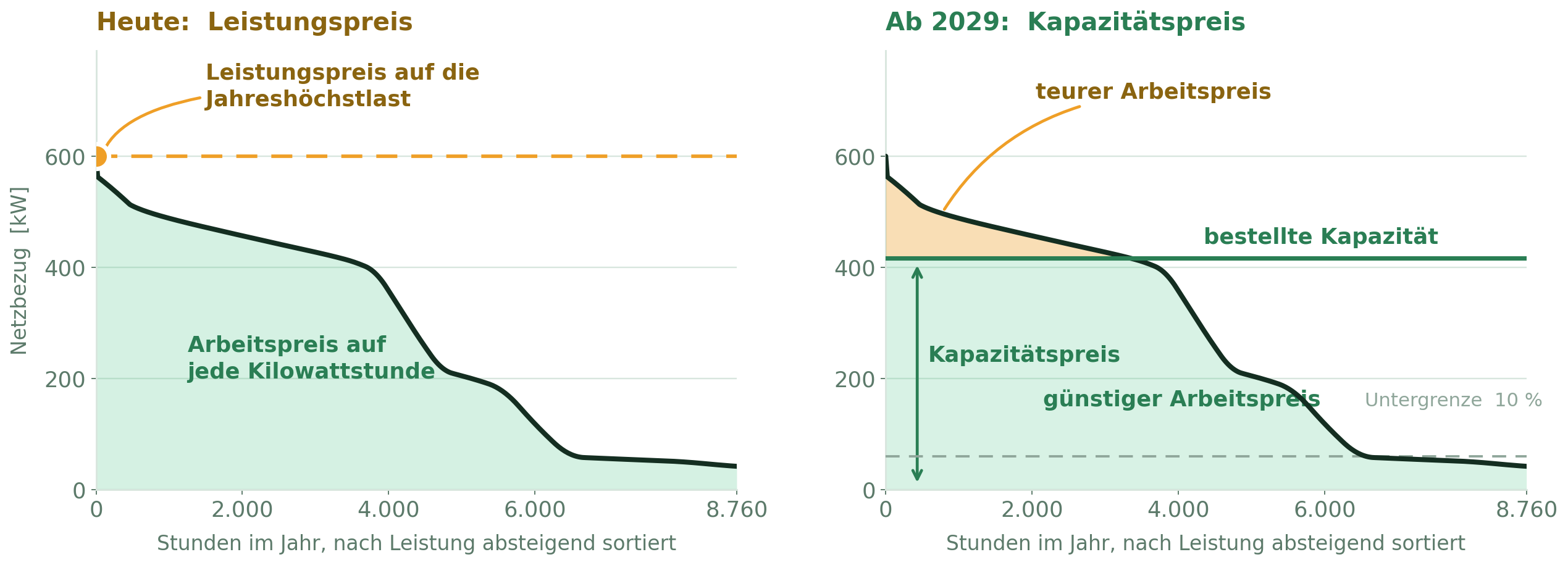
Left, today. The demand charge depends on a single 15-minute interval, the highest of the year. The energy charge runs evenly across the whole area below it. This gave rise to the logic on which practically every commercial and industrial (C&I) storage case of the last ten years rests: if you shave the one peak, you lower the demand charge for the whole year. A 2-hour storage system can do this because it only has to cover a single interval.
Right, from 2029. The customer sets the capacity in advance. Everything below it costs the low energy charge, everything above it the high one. Exceeding it remains allowed at any time. It is not a sanction, just a higher marginal price. The annual maximum load no longer appears in the bill at all.
Where the ordered capacity ends up
The decisive question is how much to order. The answer lies entirely in a single number, and its unit is hours. We call it h*, the draft itself does not name this quantity:
h* = capacity charge ÷ (AP2 − AP1)
The idea behind it is simple. Ordering one kilowatt less saves the capacity charge. But in every hour in which you exceed the order, it costs the difference between the two energy charges. The two balance out at exactly h* hours of exceedance. The cost-optimal capacity is therefore the power that is exceeded for exactly h* hours a year, in the duration curve the point where the vertical line at h* meets the curve.
In practice this means you can read the ordered capacity off your own duration curve as soon as the price sheet of the grid operator is published. You do not need a solver, but you do need the load profile.
Why the storage system loses out
This also explains why the value of a storage system shifts. Today, it is enough to cover one interval. In future, a storage system has to push the load below the ordered capacity over h* hours before the order can be reduced at all. Depending on the price sheet of the grid operator, that is several thousand hours a year. This is a completely different requirement for energy content and cycle count, and it hits short-duration storage systems hardest.
A single load peak therefore no longer ruins the annual result. That was so far the central selling point of many commercial and industrial (C&I) storage systems. If your storage cases today rest mostly on peak shaving, recalculate them. The value of the storage system shifts from peak avoidance to responding to market prices. Atypische Netznutzung (atypical grid usage under § 19(2) StromNEV, reduced grid fees for shifting load out of HLZF) and the 7,000-hour baseload rule are being phased out anyway, for existing cases by the end of 2031 at the latest, with a frozen discount.
The corridor caps what a grid operator can incentivise at all
One point is missing from the discussion so far: h* cannot become arbitrarily small. Because AP2 may be at most 350% of AP1 and the energy charge share is at most 60% of costs, the denominator of the formula has an upper limit, and h* therefore a lower one.
In our example calculation with a synthetic medium-voltage cohort, this lower limit is around 1,400 hours. The exact value depends on the load distribution of the respective grid area, but the order of magnitude is likely to be typical. The consequence holds regardless: no permissible price sheet of the grid operator can address peaks narrower than h* min through the capacity charge. If you cover them, you only save the energy charge surcharge.
The corridor thus caps exactly the range in which short-duration flexibility has an effect. From the grid's perspective, this needs explaining: the reform wants to incentivise grid-supportive behaviour more strongly, but at the same time limits how strong this incentive may be. We think this is a point that belongs in the consultation.
Incidentally, these limits do not come from the draft of August. They were first quantified in the interim version of 27 May 2026 and then adopted unchanged. The consultation until 18 September 2026 was therefore the first formal opportunity to comment on them.
{{use-case}}
§ 118(6) EnWG: The deadline falls on 31 December 2026
The sharpest date in the whole draft concerns not 2029, but 31 December 2026.
Grandfathering under § 118(6) EnWG only applies to storage projects that made a final investment decision before the determination was announced. The draft defines this precisely: binding orders for at least 50% of the investment volume, from which you cannot withdraw without substantial financial loss. And it quantifies what counts as substantial: in any case from 25% of the investment volume in threatened losses (para. 500). Proof must be with the grid operator by 31 March 2027.
Paragraph 518 makes the consequence unmistakable: if you have no investment decision by the time of the announcement, you fall under the new charging system from 2029. This applies even if the system meets the statutory commissioning deadline of 4 August 2029. The deadline in the law alone does not save the grandfathering.
For all projects in the pipeline, this means: the question of "with or without capacity charge" is decided by orders and contractual penalties that are fixed by the end of 2026. For tender projects with a realisation obligation backed by penalties, the bid date at least counts as the investment decision.
{{cta}}
Our conclusion: Scenarios instead of constants
There is a fair amount to criticise in the draft, and we do so at the points mentioned. The direction is still right: storage systems are moving from a regulatory special case to a normal market participant, with revenue opportunities and a share of the costs.
What changes fundamentally is the order of planning. Until now, systems were sized, built and then billed. In future, the economically decisive choices are made before the investment: feed-in capacity, ordered capacity, the metering concept for the energy charge exemption and the timing of the investment decision. And because AgNes (BNetzA reform of German grid fees towards capacity-based pricing) is still a draft, grid fees belong in the calculation as a scenario, not as a constant, in every business case that runs beyond 2029.
None of these questions can be answered with a table. They depend on the load profile of the site, the storage size and the price scenario. This is no longer an Excel task, but quarter-hourly optimisation across two charging regimes.
In practice, this means you should not wait but calculate. In minimum energy, the capacity charge is already set up as a component, so you can estimate the economic impact of the draft today. A translation module converts today's demand-based grid fees into the new capacity charge logic, so you can compare both regimes directly on the same storage system, with all opportunities and risks.
This is exactly what the recording of our webinar from 27 August shows: the AgNes draft applied to a real storage case, once under today's fee system and once under the planned one, calculated in minimum energy.
Frequently asked questions about grid fees in 2029
When does AgNes come into force?
The determination is due to be published on 1 January 2027. The new grid fees apply from 1 January 2029, and the StromNEV continues to apply until then. 1 January 2027 is also the cut-off date for the protection of legitimate expectations.
How high is the capacity charge for storage systems?
According to the model calculations in the draft, around €5 per kW per year, levied on 100% of the contractually agreed grid connection capacity. The historical range of the calculation basis is €3.20 to €6.10, smoothed over a rolling five-year average.
How much capacity should I order?
The cost-optimal level is the power that is exceeded for exactly h* hours per year, with h* = capacity charge ÷ (AP2 - AP1). The metric is measured in hours and is the same for all customers on the same price sheet of the grid operator. What differs is where it lands on each customer's annual load duration curve. The ordered capacity must lie between 10% of the previous year's annual peak load and the contractually agreed grid connection capacity.
Until when does the grid fee exemption under § 118(6) EnWG apply?
Grandfathering protection only applies to projects with a final investment decision before the determination is published, so by 31 December 2026: binding orders for at least 50% of the investment volume, withdrawal only possible with substantial financial loss, and proof by 31 March 2027.
What happens to atypical grid use?
It is being phased out. Existing customers with a valid agreement on the cut-off date can continue to use it until the end of 2031 at the latest, with a frozen discount. New agreements under the system of § 19(2) StromNEV are no longer planned from 2029.
Sources: BNetzA (Germany's Federal Network Agency), Grand Ruling Chamber for Energy, draft determination on the general grid fee system for electricity supply networks (AgNes), GZ GBK-25-01-1#3, consultation until 18 September 2026. Paragraph numbers refer to the draft and may shift in the final version.
We use AI to support research, structuring and language editing. minimum.energy is responsible for the technical content, classification and approval. Figures, claims and project-specific statements are checked before publication.
AgNes capacity charge: what happens to the peak shaving calculation from 2029
Same site, same storage system, new grid fee system: the value contribution from peak shaving falls from €19,602/a to minus €4,258/a. The return falls from 11.8 to around 7 per cent.

11,8%
7,3%
-100%
43.5k
Webinar recording: Grid fees 2029
In the recording, Felix, Leander and Leon work through what the AgNes draft does to a real storage system. Once under today's fee system, once under the planned one, directly in minimum energy. Scenarios instead of forecasts, 45 minutes.